info@hndassignmentwriters.co.uk
  +44 7933 142807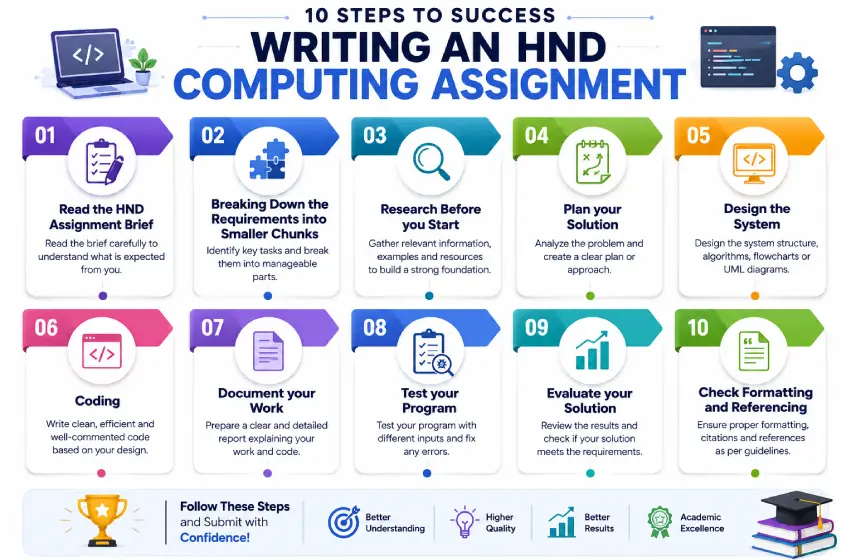
Attention HND students!
Do you ever open your HND computing assignment brief and wonder, “Where do I even start?” You are not alone.
It is intimidating to combine programming, writing, and evaluation in your paper. However, when you understand the process, it all becomes easy.
That is what this whole blog is all about! Here you will learn the steps to write your HND computing assignment with confidence.
So, let's start!
Step 1: Read the HND Assignment Brief
Before you begin writing a single line of code or text, take time to read the assignment brief. To understand what to do, look following in the assignment brief:
-
The task requirements
-
The learning outcomes
-
The grading criteria
Many students fail to score because they forgot what they were asked to do. So, highlight keywords like design, implement, evaluate, and test. These words will give you a clue about what you should include in your assignment.
Step 2: Breaking Down the Requirements into Smaller Chunks
Your HND assignments might include several tasks. You need to research, design, code, test, or evaluate your work.
Does it all look confusing? So, then take it step by step. It will become easier. Break down the assignment into smaller parts, such as:
-
First task: Research or explanation
-
Second task Design
-
Third task: Programming
-
Fourth task: Testing and evaluation
By this step, you can write your HND computing assignment with ease.
Step 3: Research Before You Start
Though it is a computing assignment, you need to research. The research will help you justify your decisions. That is to say, your research might include:
-
Programming languages or tools
-
Similar systems or applications
-
Best practices in design
For example, if you are making a database, explain why you used MySQL instead of another one.
Step 4: Plan your Solution
Don’t jump straight into coding. When you skip planning, you are more likely to make mistakes and waste time fixing them later. So, take a few minutes to plan first. This can save you hours.
You can include the following in your plan:
-
Flowcharts
-
System diagrams
-
Wireframes
-
Pseudocode
The planning shows your examiner that you understand the problem.
Step 5: Design the System
This is the stage where you show exactly how your solution works. You explain the structure, how different parts connect, and how users will interact with it.
So, you can add the following to your explanation:
-
System architecture
-
Database design
-
User interface
Moreover, you can use diagrams and screenshots to illustrate your work. The pro tip is to seek assistance from a service that offers HND Computing Assignment Help. They can help you create a good design that makes coding a lot easier.
Step 6: Coding
It is finally time to write the code. Follow these simple tips when coding:
-
Keep your code tidy
-
Use good variable names
-
Add comments to explain what you are doing
Beware! Don’t copy code from the internet without understanding what the code does. Your examiner will know that the code is not yours. So, seek professional help to create a design and understand code.
Step 7: Document your Work
Documentation is as important as coding in HND assignments, as it explains:
-
What your code does
-
How each feature works
-
Why did you do certain things
So, anyone reading it can understand your work.
Step 8: Test your Program
Testing shows that your code actually works the way it’s supposed to. It helps you catch errors and confirm results. Moreover, you can prove that your solution meets the assignment requirements.
So, your test plan might include:
-
Test cases
-
Expected results
-
Actual results
-
Screenshots
Example Test Case:
|
Test |
Input |
Expected Result |
Actual Result |
|---|---|---|---|
|
Login |
Correct password |
Access granted |
Access granted |
Testing shows your work is professional and has attention to detail.
Step 9: Evaluate your Solution
In the evaluation part, you reflect on your work. That is to say, you write about:
-
What worked well
-
Challenges that came up
-
What your system lacks
-
What could be improved in the future
In the part of your HND assignment, you show your critical thinking skills. This helps you score high marks.
Step 10: Check Formatting and Referencing
In this final step, you review your assignment to make sure the following is correct:
-
Formatting
-
References
-
Presentation
Even though it is a technical HND assignment, a proper presentation shows professionalism.
4 Most Important Tips For a Successful HND Assignment
Do you dream of submitting an HND Computing Assignment? The structured one, all code working, diagrams clear, and documentation neat. To achieve that, follow these simple 4 tips:
-
Start early
-
Adhere strictly to the marking scheme
-
Keep your work well-organised
-
Make sure your work has been properly proofread
With these tips, you can make your dream a reality. All you need to do is carefully plan and pay attention to detail.
Final Thoughts
Listen, HND students!
Writing an HND computing assignment is a daunting task. However, it becomes much easier if you understand the process. All you need to do is follow the guidelines and demonstrate your understanding.
Your assignment is not all about creating a program. You explain how and why you created the program. That is how you can prove your worth as a computer professional.
Take your time and follow each step. This way, you won’t just complete your assignment. You will also build skills that prepare you for a successful career in computing.