info@hndassignmentwriters.co.uk
 +44 7933 142807
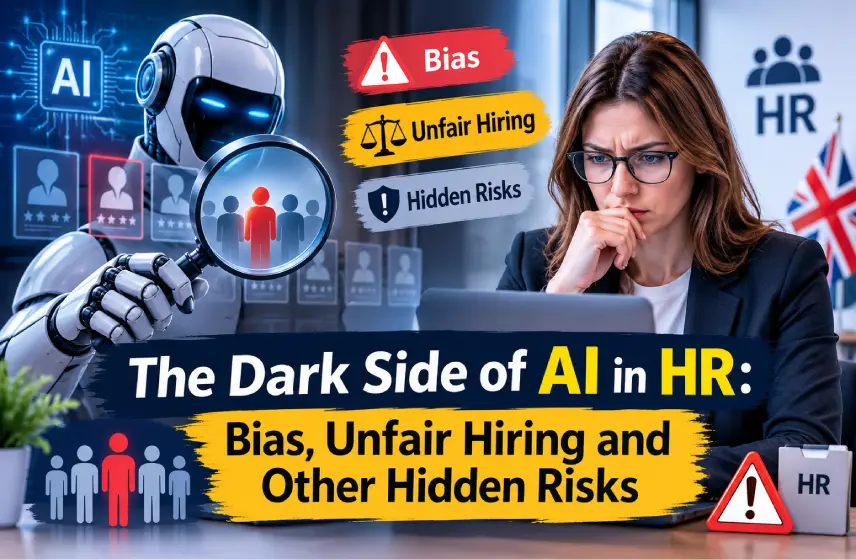
Artificial Intelligence (AI) has become a major part of every industry. The incorporation of AI in HR has changed how organisations recruit and assess candidates, and manage workflow. From screening CVs to analysing interview responses, AI-powered tools have reduced administrative work and assist HR teams in deciding faster. However, faster decisions do not always mean right decisions.
Let’s take an example of a qualified candidate who got rejected before his CV reached a human employer. The candidate possesses relevant experience, required skills and an employment record. But an automated screening system ranks their application below others. Was the decision based on their suitability for the role, or did the system overlook valuable experience because it did not match its preferred criteria?
This has become one of the significant concerns of applicants and employers in the UK. For UK employers, the challenge is to benefit from automation without sacrificing fairness, transparency and accountability.
What Are the Risks of Using AI in HR?
The main risks of using AI in HR include discriminatory hiring outcomes, algorithmic bias, privacy violations, inaccurate assessment and excessive reliance on automated recommendations. These AI risks in the workplace can affect recruitment, employee performance evaluation, and promotion decisions, ultimately leading to wrong decisions.
What causes these risks of using AI in HR? AI systems operate based on patterns in the data and follow programmed criteria; on that basis, these tools generate recommendations. Therefore, if it receives incomplete data or is not properly monitored, the outputs can become disadvantages for the applicants, employees and disrupt workforce operations.
Consequently, these risks of AI in HR depend on how humans use it, the decisions it supports and the safeguards an organisation puts in place. Having a strong understanding of these factors is essential before introducing AI into HR workflow.
How Does AI Bias Make Unfair Hiring Decisions?
An Artificial Intelligence system makes systematic, prejudiced decisions that disadvantage certain job candidates based on protected characteristics, such as age, gender, race or background. Studies from organisations like Stanford Human-Centered Artificial Intelligence (HAI) show that automated screening can disproportionately reject minority applicants compared to baseline expectations.
Moreover, such bias can emerge from historical data, poorly chosen assessment criteria or assumptions that do not accurately measure an individual’s potential to perform.
Historical hiring data can reinforce existing discrimination
Feeding AI past data teaches it that yesterday’s inequalities are the standard for tomorrow’s success.
AI tools are trained to identify a company’s top performer or longest-tenured employee. So, if a company predominantly hires men or individuals from a specific socioeconomic background for leadership roles, AI perceives those specific demographics as the fundamental ingredients of “success.”
For example, the Amazon case study is the best example to understand this. It scrapped an internal resume-screening tool after finding out that it penalised resumes containing the keyword “women’s” (e.g, women’s chess club captain).
CV screening algorithms can overlook qualified candidates
Research indicates that over 60% of recruiters admit AI filters eliminate candidates before a human ever lays eyes on those resumes. In fact, studies show that 27% to 35% of recruiters explicitly report missing out on top talent because automation stripped away human intuition.
-
AI favours AI loophole: Recent studies show that candidates who seek help from AI to rewrite and optimise their CVs are up to 60% more likely to be shortlisted than equally qualified candidates who write their CVs manually.
-
Formatting glitches: Applicant Tracking System (ATS) parsers may struggle to read unconventional layouts, graphs, tables or unique fonts. (Years of experience, skills and abilities get wasted).
-
Penalises non-linear career paths: AI is programmed to reward linear, predictable patterns. Candidates with career gaps or who have changed industries are often penalised before reaching the human employer.
AI assessments may disadvantage disabled and neurodivergent applicants
AI hiring assessments frequently disadvantage disabled or neurodivergent applicants by standardising human behaviours. AI tools are built around algorithmic models of “normalcy”. Therefore, they mistake natural variation in speech, movement patterns of thoughts, and resume formatting as indicators of low competence or poor job fit.
These indicators include:
-
Audio and speech parsing failure: Unusual pacing, longer processing pauses, word repetition or atypical prosody (vocal tone) result in a garbled text transcript.
-
Gamified cognitive assessment: Many employers replace traditional tests with gamified cognitive assessment (e.g, rapid-fire puzzle solving, memory tasks, pattern matching). These tasks have extremely high pressure and sensory overload, which actually has nothing to do with job performance. A highly capable engineer, designer or accountant with ADHD or dyspraxia might underperform in these tasks.
-
Automated gatekeeping blocks human accommodation: Legally, candidates are entitled to reasonable accommodations. However, automated platforms create barriers, such as:
-
Most platforms do not transparently disclose how the AI evaluates candidates, which makes it impossible for an applicant to know what kind of accommodation to request.
-
Requesting an exemption from an AI portal often creates massive technical delays or bugs, which results in the application failing or timing out before a human ever reviews it.
The risks of AI in HR do not end here. It goes beyond recruitment bias, which is explained below.
What Other Hidden Risks Does AI Create in HR?
The risks of AI in HR go far beyond the initial hiring filter. Once an automated tool is integrated into an organisation, it can distort employee engagement, create legal liabilities and also damage company culture across the entire employee lifecycle.
1. The “Black Box” Penalty in Performance Reviews
Many organisations use AI to monitor productivity by tracking keystrokes, email response time or calendar activity.
-
The Risk: These systems create a “black box” where employees are scored by a hidden formula they cannot see or challenge. In addition, these algorithms focus on easily quantifiable metrics (like volume of email sent). They penalise good-performing employees who focus on qualitative tasks such as strategic problem-solving, mentorship or creative collaboration. As a result, overreliance on these metrics leads to low employee morale and poor retention.
2. Privacy Violations and Biometric Surveillance
HR departments use AI-led sentiment analysis tools to scan internal communication channels (like Slack or Microsoft Teams). Or use facial-analysis software during virtual meetings to assess employee engagement and burnout.
-
The Risk: This kind of monitoring triggers massive data privacy liabilities. Collecting biometric data or tracking behavioural patterns of employees without their informed consent results in financial penalties under frameworks like Europe’s General Data Protection Regulation (GDPR).
3. Legal Vulnerabilities in Automated Offboarding
AI models in HR are now being used for predictive attrition (finding which employees are statistically likely to quit or underperform) and even assisting in selecting cohorts for corporate layoffs.
-
The Risk: AI tools which are programmed on flawed historical data are more likely to flag older workers, remote workers, or women returning from maternal leave as ‘low productivity’. Hence, using AI suggestions to justify terminations without human review creates a risk of wrongful termination and discrimination lawsuits.
4. Erosion of Institutional Knowledge and Skills Rot
When HR teams rely on AI chatbots to write official policy documents, employee handbooks, or answer basic benefit questions, human oversight naturally degrades in such scenarios.
-
The Risk: Chatbot hallucinations give incorrect information about healthcare benefits, safety protocols, and parental leave. This leads to compliance failure. Furthermore, junior HR professionals lose the opportunity to learn foundational law and conflict resolution because the machine handles all entry-level work. This creates a long-term leadership and skill gap.
A strong understanding of the risks of AI in HR has become more crucial than ever before, and it also highlights the importance of studying ethical HR practice, employment law and fair decision-making. For aspiring HR professionals and students who are exploring these issues in their coursework, you can seek HND human resource management assignment help from experts for topics such as AI-driven recruitment, workplace discrimination and employee data privacy. These subjects focus on how AI tools are changing HR responsibilities and why human oversight remains essential to manage workers fairly.
What Does UK Law Say About AI in HR and Recruitment?
The UK does not have dedicated, AI-specific employment legislation. Instead, employers who use AI in HR must comply with a patchwork of existing statutory laws, data protection rules and official guidance.
Equality Act 2010 and discriminatory recruitment
The Equality Act 2010 makes it unlawful for employers to discriminate against job applicants across nine protected characteristics at every stage of the recruitment process. In addition, the discrimination laws cover these specific personal traits:
-
Age.
-
Disability.
-
Gender reassignment.
-
Marriage and civil partnership.
-
Pregnancy and maternity.
-
Race (including colour, nationality, ethnicity).
-
Religion or belief.
-
Sex
-
Sexual orientation
Furthemore, according to ACAS, unlawful recruitment practices generally fall into these categories:
-
Direct Discrimination: Treating a candidate less favourably because of a protected characteristic (rejecting someone because they are old or pregnant).
-
Indirect Discrimination: Applying a rule, criterion, or practice to everyone that puts people with a particular protected characteristic at a substantial disadvantage (e.g, requiring unnecessary physical or location criteria).
-
Failure to make reasonable adjustments: Not adapting the recruitment process for a disabled applicant (e.g, refusing to provide an accessible interview room or alternative application format).
-
Harassment and Victimisation: Subjecting an applicant to unwanted behaviour related to a protected characteristic or penalising them for raising a discrimination concern.
Consequently, if any of the above unlawful recruitment occurs via an AI tool, the employer is kept guilty for it.
UK GDPR and the Data Protection Act 2018
Data protection rules restrict how AI tools can be used to screen, rank and reject applicants. The legal framework changed significantly under Section 80 of the Data (Use and Access) Act 2025. In addition, it overhauled rules around Automated Decision-Making (ADM).
The core points of this legal framework include:
-
The Right to Know: Employers must explicitly inform the candidate if AI is being used for automated decisions.
-
The Right to Challenge: The applicant possesses a legal right to request human reconsideration if a machine rejects a candidate without human intervention.
-
Rubber-Stamping is Illegal: The Information Commissioner's Office (ICO) explicitly warns that a human manager briefly clicking “approve” on an AI-generated shortlist does not count as human oversight. Hence, the human viewer must possess the actual authority, competence and discretion to overturn the AI’s scoring.
Final Verdict: Should Employers Stop Using AI?
No matter how efficient AI could become, faster hiring process and make HR tasks easier. It cannot replace human judgment, empathy and accountability. These AI systems are programmed on previous data, and hence they make decisions as per that information, which leads to biased hiring and intrusive employee monitoring, which harm both workers and organisations when left unchecked.
So, should employers not use AI? Well, using AI is not the main problem. Ensuring human oversight is essential. Also, UK employers must understand the Law about using AI before incorporating it into their systems.
Frequently Asked Questions
1. What are the disadvantages of using AI in HR?
The main disadvantages of using AI in HR centre around algorithmic bias, a lack of transparency, privacy vulnerabilities, and the erosion of human empathy.
2. What is the 30% rule of AI in HR?
The 30% rule of AI in HR defines how labour and decision-making should be split between artificial intelligence and human resource professionals. AI is restricted to handling or drafting 30% of an output or workflow, while human professionals drive 70% of the critical thinking, ethical evaluation and context-checking to prevent unverified machine errors or bias.
3. How can HR professionals prevent AI bias in recruitment?
HR professionals can prevent AI bias in recruitment by ensuring historical datasets do not mirror past societal or organisational inequalities. They must also check vendor tools that show why a candidate is recommended rather than relying on a “black box.” Also, HR professionals should never allow AI to make automated unreviewed rejections or final hiring choices.
4. What UK laws regulate the use of AI in recruitment?
The UK does not have a single, standalone AI law governing recruitment. Instead, it relies on a patchwork of existing legislation, data protection rules and non-statutory governance principles enforced by sector regulators. The key governing laws and framework include: the Equality Act 2010, UK GDPR and the Data Protection Act 2018, the Human Rights Act 1998 (Article 8) and Common Law.