info@hndassignmentwriters.co.uk
 +44 7933 142807
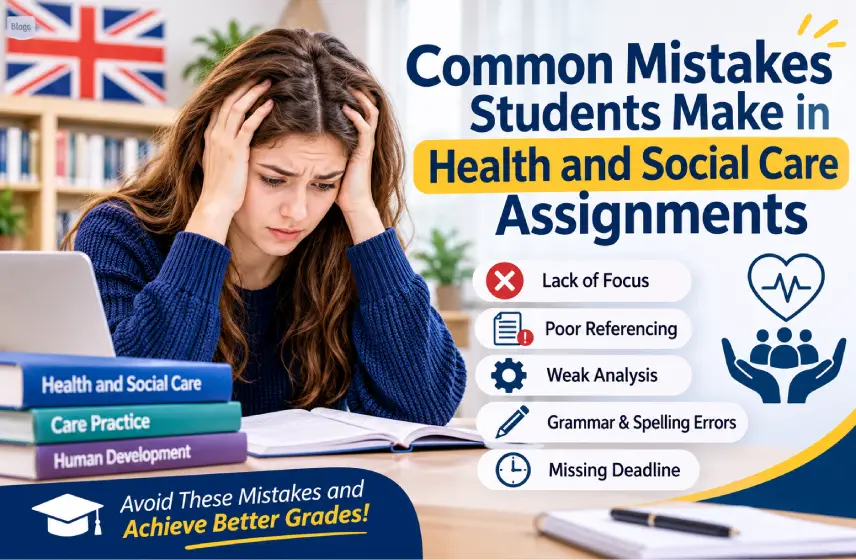
Healthcare and social care assignments are not just about explaining concepts in healthcare. Researching a topic, applying theory, analysing evidence, discussing practice and showing knowledge of the context of care situations are all common requirements for students. This necessitates that even if pupils have the correct knowledge, they are prone to errors that may impact the quality of their work.
It's important to understand what common mistakes students make with health and social care assignments so you don't fall into those same traps and create more focused, clearer coursework. Many things, from understanding the question of the assignment to using weak sources, can make a big difference in your final grade.
1. Not Understanding the Assignment Brief
The easiest error to make is to begin writing without comprehending the assignment brief. Students can read the topic but forget to explain, analyse, compare or evaluate what is being asked.
Analyse, evaluate, discuss and assess mean different things. For example, if you are asked to assess a care approach, you can't simply describe what the approach is.
When composing, divide the question into smaller sub-questions and determine what your tutor is expecting you to address.
2. Over-Dependence on Description
In health and social care assignments, analysis is required rather than just description. Descriptive answer: "What is it?"Analytical answer: "Why is it important? How does it work? What does it do?
For instance, a description of what person-centred care is is descriptive. Demonstrating a deeper analysis will be achieved by a discussion on how person-centred care can impact an individual's dignity, independence and wellbeing.
3. Using Unreliable Sources
Another popular issue is the use of information from random websites, blogs, or any information without verifying the source. Health and social care is an evidence-based subject, and what you say does matter because of the quality of your sources.
If appropriate, refer to academic journals, books, government documents, professional organisations and other reputable sources. Verify the accuracy, relevance, and evidence of information.
You can also hire Health and Social Care Assignment Helper to assist you if anything seems difficult to you.
4. Using Outdated Information
Policies, guidelines, practices and laws regarding health care may vary over time. If the information in an assignment is no longer relevant, it will be less impactful as a result.
This is especially relevant when talking about safeguarding, data protection, healthcare policy, standards of practice or practice today.
Be sure to verify the date of publication of key sources and ensure that your information is relevant to the needs of your course and the context.
5. Failing to Apply Theories
It is common for many health and social care assignments to involve talking about theories or models. Often an explanation of a theory is not linked to the question or the case study.
If you are talking about Maslow's hierarchy of needs, stating the 5 levels is not a good application.
Rather, describe the connection between the theory and the person's physical, emotional or social needs in the context you are examining. Using theory to answer actual or imagined questions shows a higher level of knowledge about the topic.
6. Ignoring the Individual's Needs
Health and social care is ultimately focused on people. If students do not keep in mind that the person is at the heart of the discussion, they may go through the motions and end up with a very abstract assignment.
If you are looking at a case study or care situation, think about age, physical and mental health, communication needs, culture, independence, preferences and social factors as appropriate.
A person-centred approach acknowledges that people have various needs and experiences. This should not be an assignment that proposes that there is one solution for everyone.
7. Making Unsupported Claims
Pupils occasionally say that 'this approach will always enhance wellbeing' or 'communication issues lead to poor care' but with no evidence.
The Academic Writing Policy states that claims must be supported as appropriate. When making an important description about health, behaviour, care outcomes or professional practice, seek reliable evidence for it.
Assignments should not be based on evidence just to make them appear academic. Discuss how the evidence supports your ideas and relate that evidence to the discussion.
8. Poor Referencing and Plagiarism
Another frequent error is incorrect referencing. Students can miss citations, have incorrect formatting, or provide citations that do not match the main assignment.
Plagiarism can also happen when a student quotes without giving proper credit to a source or when he or she or another individual copies content without proper documentation. Typically, some sort of citation is required in an appropriate format.
9. Weak Structure and Organisation
A good assignment should have a logical organisation. The ideas should flow from the introduction to the main discussion and continue into the conclusion.
Try not to change topics from one unrelated subject to another. Where applicable, use headings and ensure paragraphs have a clear purpose.
10. Not Proofreading the Final Assignment
A well-researched paper can fail in quality due to simple spelling, grammar, punctuation, or formatting errors.
Once you have written your first draft, carefully proofread it. Review your paragraphs for clarity, logic in your arguments, and consistency in your references.
Final Thoughts
It is important to know what students tend to do wrong in health care and social care assignments so that you can work on your health care course more effectively. Issues including inadequate research, over-description, inadequate referencing, lack of analysis and a failure to understand the question can impact the quality of your work.
A good health and social care assignment is based on accurate knowledge, critical thinking, reliable evidence, relevant theories and application. With careful planning, a focus on your discussion, and a check before handing in, you can create clearer, more academically productive assignments.