info@hndassignmentwriters.co.uk
  +44 7933 142807
An HND assignment might be stressful, particularly when you are hoping to get a distinction.
You can know the subject, go to lectures consistently, and still ask yourself why there are students who are doing better than you.
The fact is, it is not a matter of writing more to get a distinction, but writing smarter.
No matter whether you are studying under Pearson or under the BTEC framework, HND assignments are evaluated in accordance with certain criteria. When you know those standards and organize your work in the right way, you have a high possibility of getting the best grades.
So, in this guide, I will tell you about the best strategies that can help you get a distinction in your HND assignments.
So, let us get started!
Understand the Distinction Criteria First
You have to know what a distinction really is before you begin to write.
Most HND courses have grades which are divided into:
-
Pass
-
Merit
-
Distinction
A pass result shows that you have met the basic passing criterion.
A merit demonstrates fine knowledge and practice.
Whereas a distinction requires:
-
Critical analysis
-
Strong evaluation
-
Independent thinking
-
Clear structure
-
Professional presentation
Therefore, you need to read the requirements of your assignment very carefully and highlight:
-
Learning outcomes
-
Keywords (analyze, evaluate, compare, justify).
-
Assessment criteria
No matter how well you write, you will not win a distinction unless you provide the exact answer to what is being requested by the brief.
Tips to Get A Distinction in HND Assignments
Here are some tips to help you earn a distinction in your HND assignments:
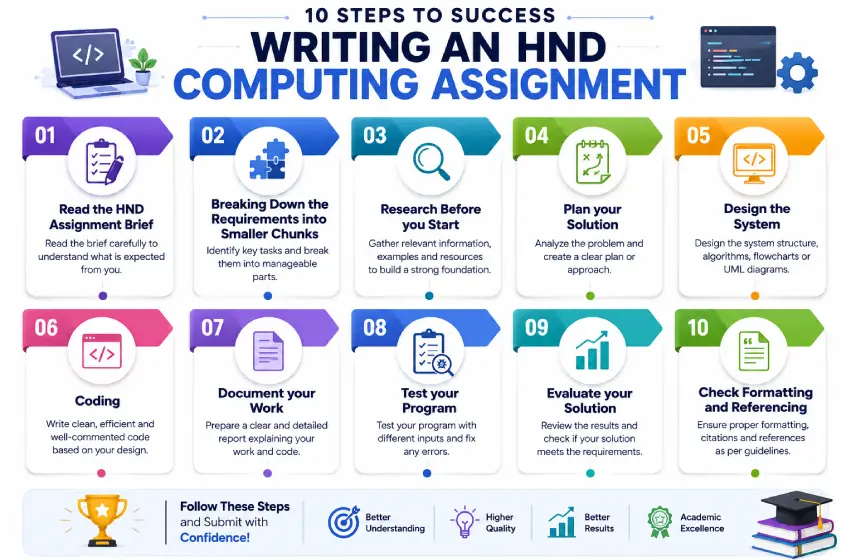
Plan Before You Write
Starting without a plan is one of the greatest errors that students commit. Hence, before starting to write, you must:
-
Break down each of the tasks given in the assignment brief.
-
Examine the research key theories, models, and case studies.
-
Develop headings and subheadings.
Planning assists you in focusing and also makes sure that you address every necessary thing. It is also relevant in preventing repetition and irrelevant information - a factor which normally drops grades.
Conduct Strong Academic Research
The distinction-level assignments are challenging to demonstrate.
Other than taking class notes, use
-
Academic journals
-
Textbooks
-
Industry reports
-
Government publications
-
Credible websites
In research, search for new and current sources. The more recent your sources are, the better your assignment is.
Do not use any random blogs or unreliable sources. The academic credibility of your content really matters.
Structure Your Assignment Properly
The importance of presentation and structure is enormous in HND assignments.
So, the structure of your HND assignments must include:
1. Introduction
The intro of your assignments must:
-
Briefly explain the topic
-
State the objective of the assignment
-
Summary of the discussion points
Keep it clear and focused. Do not put irrelevant information here.
2. Main Body
This is the place where you get your distinction.
Each of the paragraphs should:
-
Start with a clear sentence on the topic
-
Discuss a model, a concept, or a theory
-
Connect it with your case study or scenario
-
Analyze and evaluate it
-
Support it with references
To be different, do not simply describe theories, but analyze them. This critical style demonstrates advanced thinking.
3. Conclusion
Finally, the conclusion should:
-
Summarize key findings
-
Respond directly to the question of the assignment
-
Avoid presenting any new information here
A powerful conclusion supports your knowledge and gives an impact of professionalism.
Focus on Critical Analysis
The focus on critical analysis can be a game-changer for your assignments.
The descriptive writing tells what.
Analytical writing is explanatory in nature, why and how.
For example:
Descriptive:
“There are five levels of Maslow's hierarchy of needs.”
Analytical:
“Although the theory developed by Maslow is a handy guide to motivation, it has been criticized as being empirically weak and implying that needs occur in a clear hierarchy.”
Just check out the difference here. Distinction level writing never leaves out:
-
Evaluation
-
Comparison
-
Justification
-
Evidence
This critical thinking alone can help you get a distinction. And if you don't know how to do it. You can take help from expert HND Assignment Help in the UK.
Use Proper Referencing
Wrong citing would lead to a loss of marks.
The majority of the HND courses demand the use of Harvard referencing. So, you need to make sure that you:
-
Cite all sources in-text
-
Give a complete reference list.
-
Follow a consistent formatting throughout
Even if your content is good. The poor referencing of content might cost you your grades.
A great number of referencing tools exist, yet never forget to check the formatting by hand.
Proofread and Improve
Always proofread your draft before submitting it to your professors. Therefore, always:
-
Check grammar and spelling
-
Remove repetition
-
Improve unclear sentences
-
Make sure that you have all the learning outcomes.
-
Verify references
Reading aloud can enable you to identify clumsy sentences in your work.
Final Thoughts
In a nutshell, it is quite possible to write an HND assignment to receive a distinction. But it needs strategy, planning, and critical thinking.
Working at the distinction level does not mean writing more pages. It is more about showing the higher level of knowledge, own thinking, and professionalism.
So, make sure that you are following the right approach to write your HND assignment to get a guaranteed distinction this time.
Happy Writing!
Frequently Asked Questions (FAQs)
1. How many words should an HND distinction assignment be?
The number of words will be based on the assignment brief. But the length is not as important as the quality. Pay attention to both ends of the learning outcomes and do not just cover them with words.
2. Is it hard to get a distinction in HND?
It is not that easy, but it is not impossible. Those students who learn about grading criteria, think critically, and spend their time in a proper manner have a high possibility of receiving a distinction grade.
3. Does referencing affect distinction grades?
Yes, it is quite crucial to reference. You can score low marks on erroneous or omitted references, despite having a good piece of work. One should never forget the necessary referencing style.